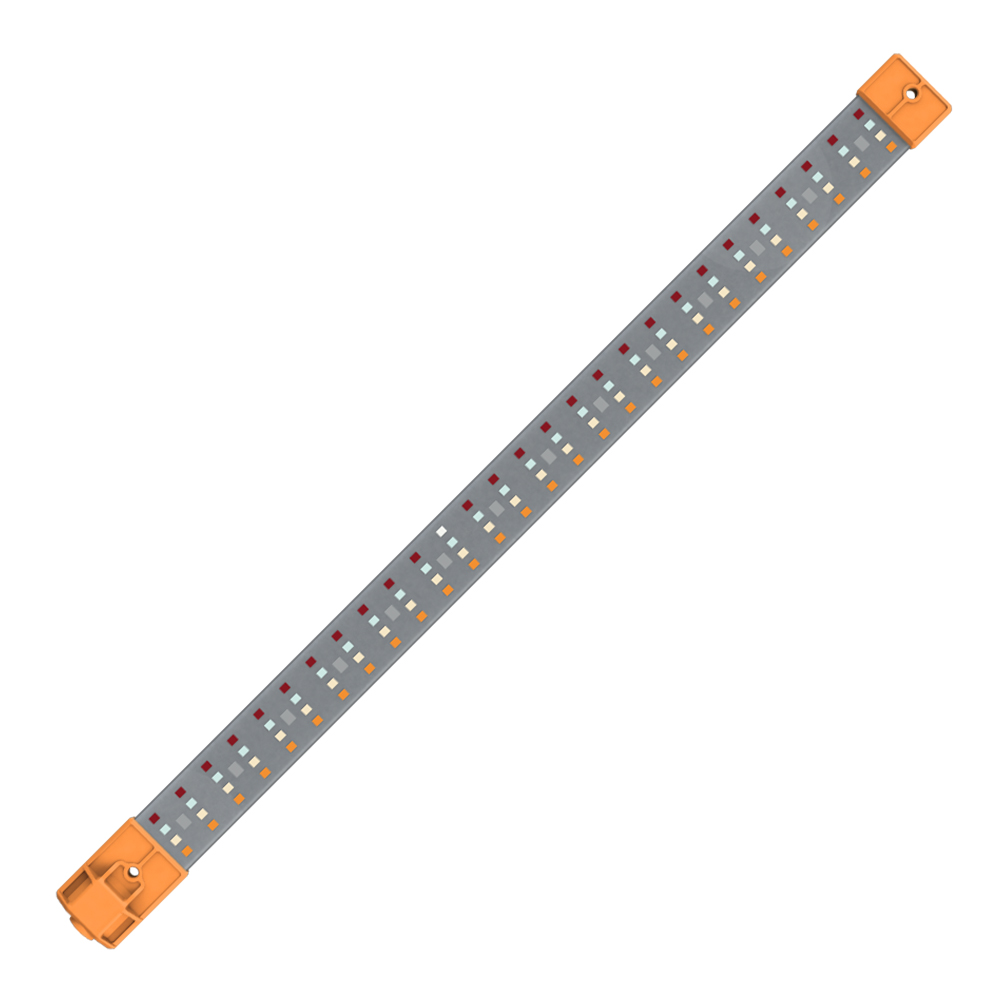

LED lighting calculator: Power, PPF, PPFD and distance of the LED to your plant

We have made an LED lighting calculator to help you know what values you should take into account to know if LED equipment is recommended for your growing area. You just have to enter the measurements (cm) of your cabinet and we mainly provide you with two values: the Power (W) and the PPF (µmol/s). The PPF in LEDs would be the equivalent of lumens (lux) in HPS equipment.
Knowing the PPF and the optimal Power for your growing area, data that manufacturers usually provide in their equipment, you will know how far to place the LED from your plant or the yield of your harvest (gr). Keep in mind that, if, for example, you want to grow in a 300x300cm space, it will give you a power of 2250 W and a PPF of 6300 µmol/s. There is no equipment that has these features, so you will have to cover your growing space with at least 4 600W LEDs.

LED lighting calculator
Calculate the recommended LED power and PPF for your growing space, the estimated yield (gr) and recommended distances from the LED to the plant, depending on the growing stage. After the calculator, we explain the basic concepts that you should know about LED lighting and how it can help you in your cultivation. Go to LED lighting calculator

LED lighting concepts
We explain the basic concepts that you should understand about your LED lighting equipment: Power (W), BY, PPF (µmol/s), Total PPF (µmol/s), Calculated PPF (µmol/s), Usable PPF (µmol/s), PPFD (µmol/s/m²) and crop size estimation with usable PPF

LED distance calculator
In this section we recommend the height at which LED grow lights should be hung depending on the power of your LED and the different stages of cultivation. We also explain the signs that you can observe in your plant to know if your LED is too close to your plants or if it's too far from your plants. Finally, you have a tool to calculate the distance of the LED from your plant Using a lux meter to determine the height of the LED to the plant.
Summary table of recommended LED powers for grow tents
| Wardrobe measurement: Length x Width (cm) | Area (m²) | Minimum recommended power (W) | Recommended maximum power (W) |
|---|---|---|---|
| 60 x 60 | 0.36 | 50 | 100 |
| 80 x 80 | 0.64 | 100 | 200 |
| 90 x 90 | 0.81 | 200 | 250 |
| 100 x 100 | 1 | 250 | 350 |
| 120 x 120 | 1.44 | 350 | 450 |
| 150 x 150 | 2.25 | 600 | 1000 |
| 120 x 240 | 2.88 | 700 | 1050 |
| 150 x 300 | 4.5 | 1100 | 1500 |
| 300 x 300 | 9 | 1200 | 2000 |
Power (W)
Some LED systems, like HPS, are classified by Watts (W) but they have nothing to do with each other. In LEDs, it will help us see the consumption of each system, but not to know the light power.
Many growers still rely on wattage to estimate the size of grow lights. However, high-efficiency LEDs now produce much more light per watt than high-pressure sodium (HPS) bulbs.
To accurately describe the amount of light a lamp can provide, we use the scientific measurement of photosynthetic photon flux (PPF). PPF is a count of photons that are at the wavelengths of photosynthetically active radiation (PAR). These photons drive photosynthesis and are the source of all energy for the plant. The amount of PPF produced by a device determines the amount of area it can cover and its harvest potential..
BY
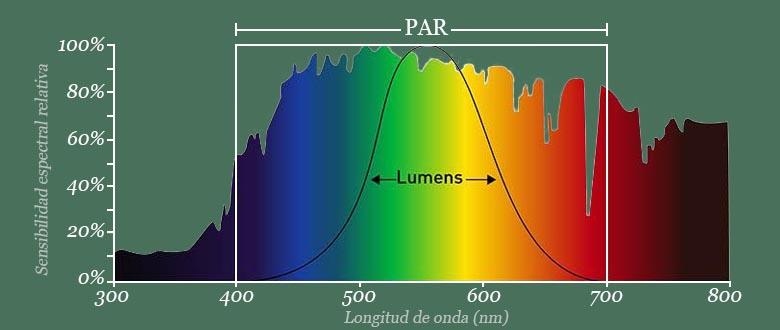
In order to more accurately measure the quality of light intended for cultivation, the concept of PAR light was developed, which stands for photosynthetically active radiation.
The first thing to understand about PAR is the part of the electromagnetic radiation (light) spectrum that is useful for plants to activate photosynthesis. When we measure PAR, we count the number of photons at the PAR wavelengths. It is these photons that are absorbed in the leaves of the plant and enhance photosynthesis. In this way, measuring PAR is very different from measuring Lux or Lumens.
The most efficient lamps for growing are those that emit the most PAR photons for each watt of electricity consumed.. If the most efficient HPS lamps produce between 1,4 and 1,8 umol/W, the best LEDs almost double this efficiency, reaching 2,8 µmol/W. It takes almost half the electricity to produce the same amount of PAR photons with a state-of-the-art LED as with an HPS bulb.
PPF (µmol/s)
The equivalent of lumens in PAR light is PPF or photosynthetic photon flux, which is measured in “micromoles per second” µmol/s and is used to describe the total number of PAR photons a device can produce per second. However, not all photons will successfully reach your plant canopy. Therefore, there are two PPF values that are important. The total PPF that an accessory can produce and the usable PPF, which is the number of photons that are directed to the canopy and can be used for photosynthesis.
Research shows that the optimal usable PPF for indoor cannabis cultivation is 700 µmol (usable PPF) per square meter of growing space. To estimate the amount of space a grow light will cover, we divide the usable PPF by 700. This shows the optimal coverage area in square meters (usable PPF / 700 = square meters). For example, a fixture that produces a usable PPF of 1008 µmol can cover an area of approximately 1.44 square meters (1008/700 = 1.44 m²).
Total PPF (µmol/s)
Total PPF describes the total amount of light emitted by a device. Total PPF measurements are taken on a device called an “integrating sphere” that measures all the photons produced by the accessory. However, even in ideal growing environments, 10-15% of these photons will be lost due to radiation or reflection. As a result, the total PPF is always higher than the usable PPF.
Calculated PPF (µmol/s)
When manufacturers provide us with PPF data for LED lighting systems, it is generally a “Calculated Value” and not an actual measurement. The calculated values are determined based on the diodes of the accessory and assume an efficiency of 100%. As a result, the calculated values are often significantly higher than the total or usable PPF.
Usable PPF (µmol/s)
Usable PPF is the measurement that matters to us as growers. The usable PPF describes the number of PAR photons that reach the plant canopy. It is the value we care about because it describes the number of photons that are available for photosynthesis. Research shows that the Optimal usable PPF for indoor cannabis cultivation is 700 µmol/m² per square meter of growing space.
For many grow lights there is no usable PPF data available. This creates problems in making accurate comparisons and calculations. Comparing the calculated PPF of one device to the usable PPF of a different device is not fair. Additionally, we need usable PPF to accurately estimate efficiency, coverage, and harvest potential.
To solve these problems, more than 60 different LED luminaires were analyzed. Patterns were found in the data that suggest that the relationship between the three types of PPF is largely predictable. The analysis reveals that the Calculated PPF is usually 18% higher than the total PPF measured in an integrative sphere and the Total PPF is usually 15% higher than usable PPF.
PPFD (µmol/s/m²)
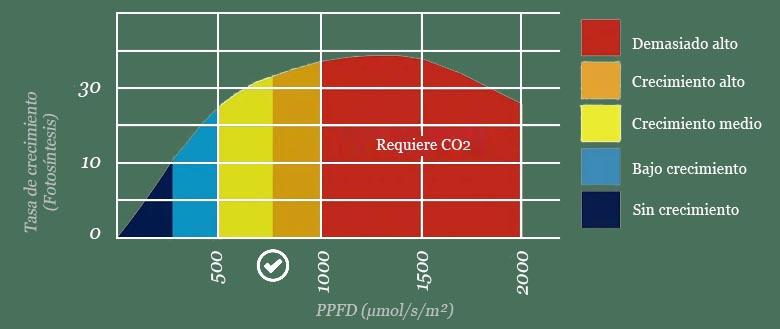 PPFD, or Photosynthetic Photon Flux Density, refers to the number of PAR photons that land on a given surface every second. When you know the PPFD, you know the amount of PAR light that reaches your crop at each measured point. This number is measured in micromoles per square meter per second, expressed as µmol/s/m².
What exactly is a photosynthetic photon? A photon is a single particle of light and can take on a variety of wavelengths. Those that are capable of contributing to photosynthesis are considered photosynthetic photons. Specifically, this includes photons with wavelengths between 400 nm and 700 nm.
PPF and PPFD measure the amount of these photons. The critical difference is that PPFD measures the density of these photons that fall on a particular surfaceWhile PPF is the total number of photons released by a light source.
Plants do not need the same PPFD throughout their lives. Germinating seeds and young seedlings are sufficient with 200 to 400 µmol/s/m², while growing plants require more light, between 400 and 600 µmol/s/m². Flowering is the phase during which they can take advantage of the greatest amount of light, between 600 and 1.000 µmol/s/m². Certain varieties, mainly sativa, can use up to 1.200 µmol/s/m². If the grow room is enriched with CO2, the maximum PPFD levels rise to 1.000 µmol/s/m² in growth and 1.500 µmol/s/m2 in flowering, as long as the varieties resist it. In any case, it does not usually pay to grow with such high levels of PPFD; From 1.000 µmol/s/m² in flowering, it is more efficient to expand the space a little than to increase the light intensity.
| Steps | PPFD |
|---|---|
| Seedling/Cutting Stage | 200 to 400 µmol/s/m² |
| Growth Stage | 400 to 600 µmol/s/m² |
| Flowering Stage | 600 to 1000 µmol/s/m² |
Crop size estimation with usable PPF
As long as growers use HPS or CMH lights, the old gram per watt rule provides an adequate estimate for a baseline crop yield. However, LED grow lights can now get up to twice the usable PPF from the same amount of wattage. Therefore, the gram per watt rule no longer applies to high-efficiency LEDs. We need to estimate harvest potential and evaluate harvest success based on grams per usable PPF rather than grams per watt.
We convert the old gram per watt rule to PPF and use 0,75 g per µmol (usable PPF) as a new reference point to evaluate the success of a crop. This conversion is based on HPS lights that have an average photonic efficiency of 1,3 µmol (usable PPF)/watt. If we consider a 600 watt HPS operating at an efficiency of 1,3 µmol/watt, it would generate 780 µmol (usable PPF). According to the gram per watt rule, we would expect good growers to harvest 600 grams. That's 600 grams per 780 µmol (usable PPF) = 0,77 g/µmol.
The harvest target of 0,75 g/µmol (usable PPF) is a good target, but it is a very high estimate. This optimal yield value will occur if you harvest high-yielding strains in a well-managed crop. To make a more realistic estimate, we use a range of 0,55 g/µmol
Height at which LED grow lights should be hung
Most LED grow light manufacturers provide height recommendations between the light and the plants, first make sure they provide you with this data to take as a reference. Keep in mind that the distance from the LED to the plant varies depending on the specifications of the LED diodes and the technology used by the equipment; there is no optimal universal height for all LED grow lights. What you should keep in mind are the following recommendations, depending on the cultivation phase your plant is in:
- Seedling/Cutting Stage: During the initial seedling stage, LED grow lights should be placed well away from the plants which are very vulnerable at this early stage and require softer light.
- growth stage: During this stage the plants respond well to intense light; This is when they mature and use photosynthesis to grow quickly. To increase light intensity, LED grow lights should be located closer to the plant canopy. Strong, healthy stems and roots are key to successful performance.
- Flowering stage: During this stage, fruit production and stem growth accelerate. As the growth of the plant moves from the growth stage to the flowering stage, it is advisable to progressively bring the LED lamp closer throughout the flowering phase.
As a reference, you can use the distances depending on the power of your LED which we provide in the following table. If you see signs of discoloration or yellow leaves, you should raise the lights about 5 – 10 centimeters. Then see if the process stops in the following days. If so, you have found the optimal height between your LED panels and your grow.
| Power (W) | Seedlings/Cuttings Height | Height Growth | Flowering Height |
|---|---|---|---|
| 100W | 40 - 60 cm | 20 - 40 cm | 10-30 cm |
| 200W | 50 - 70 cm | 30 - 50 cm | 20-40 cm |
| 400W | 70 - 90 cm | 50 - 70 cm | 35-55 cm |
| 600W | 95 - 105 cm | 75 - 95 cm | 45-75 cm |
| 800W | 105 - 120 cm | 80 - 105 cm | 50-85 cm |
| 1000W | 115 - 130 cm | 90 - 115 cm | 55-90 cm |
Signs that your LED is too close to your plants
While increasing light intensity throughout a plant's life is necessary to facilitate healthy growth, you will need to watch your plants carefully to make sure you haven't turned down the LED lights too much too quickly. Watch for the following telltale signs of distress:
- Irregular or stunted growth : usually characterized by the leaves becoming limp, curled or drooping.
- Whitening : Typically indicated by white or yellow spots on the tallest leaves.
- Burned : This usually begins with fine brown outlines on the leaves closest to the light before discoloration of larger sections manifests. Keep in mind that what sometimes seems like a mild burn may actually be a nutrient burn.
Signs that your LED is too far from your plants
Leaving lights too far from plants will make them look stretched and weak, and if not rectified, this will lead to fading and death. Sometimes it can be easy to confuse signs of insufficient lighting with accelerated growth because plants that are deprived of light will naturally grow upward at a faster rate. However, this process, known as etiolation, is not a good sign. It is the defense mechanism of a plant that seeks more light in an attempt to carry out photosynthesis.
How to use a lux meter to determine the height of the LED to the plant
To determine the height at which we should place our LED, we must calculate how much light the plant receives and compare that number with the PPFD (µmol/s/m²) that it should receive, depending on the phase it is in. Take as a reference the recommended PPFD values for each cultivation phase:
- PPFD Seedling/Cutting Stage: 200 to 400 µmol/s/m²
- PPFD Growth Stage 400 to 600 µmol/s/m²
- PPFD Flowering Stage 600 to 1000 µmol/s/m²
- If you use CO2: Up to 1.000 µmol/s/m² in growth and up to 1.500 µmol/s/m2 in flowering
Below we describe step by step how to know the PPFD that your plant receives and how to use it to adjust the height of the LED.

To obtain the PPFD, the ideal would be to have a PAR Meter, but they are quite expensive devices. But we can use a Luxmeter (see Luxmeters in Saltón Verde) which are more accessible devices, or even if your mobile phone has a light sensor, you could download one of the APPs for iPhone or Android. Once you have the lux meter, measure the Lux at the tip of your plant.

Once we have the value in Lux of the LED intensity, use the calculator that we have made to Convert LUX to PPFD . Enter the Lux measured with the lux meter and select the Light Spectrum most similar to the technology used by your LED (normally we would select "Red + Blue + White LED 450+650nm+3500K"). As a result you will have the PPFD at the tip of your plant.

With the PPFD and the distance you want to move the LED, use the tool Calculate the PPFD at a given distance to calculate the PPFD that will reach the plant when moving the LED, using the “Inverse Square Law”. Now compare the result with the recommended PPFD for the growing stage your plant is in and modify the distance until it adjusts to it.
 When moving your LED, keep in mind the “Inverse Square Law”
The inverse square law tells us that When the distance between a plant and a light is doubled, the area covered by the light increases, but the intensity of the light decreases at 25% of the original distance. In the graph you can see that the intensity at 2 meters is 25% of the intensity at 1 meter. The intensity at 4 meters is 25% of the intensity at 2 meters.
For example, let's say that the value you obtained with your Luxmeter gave you a PPDF of 1000 µmol/s/m² at 45 cm (the distance the plant was from the LED when you made the measurement). Now you know that the recommended PPFD for the stage your plant is in is 250 µmol/s/m² (Seedling/Cuttings Stage).
Then, according to the inverse square law, if we double the suspension height from 45 to 90 cm, and the light intensity would be reduced to 25% (250 µmol/s/m²) of 1000 µmol/s/m².
To make your work easier, you can use the following calculator. After calculating the PPFD with the Lux to PPFD converter, you just have to enter: (1) the distance the LED is from your plant, (2) the new distance you want to move the LED, (3) the PPFD value that you measured at that distance and we will give you the PPFD at that new distance. Adjust the distance until you have the recommended PPFD.
LED lighting in Saltón Verde
-
SunSystem | LED
1 product View All Products-
RS 1850 LED 720W LED lighting system | Sun System
799,00€ VAT included
-
-

Gavita | led
2 products View All Products-
Gavita Pro 1700e Indoor Grow LED | Gavita
1.195,00€ VAT included
-
-

Lumatek | LED
30 products View All Products-
Supplementary 30W UV LED Bar | Lumatek
The original price was: €280,00.252,00€The current price is: €252,00. VAT included
-
-

Phytolite | LED
8 products View All Products -

Secret Garden | LED
22 products View All Products-
Cosmorrow LED COP Flowering | Secret Garden
35,00€ - 60,00€ VAT included
-
-

Solux | LED
47 products View All Products -
Vanguard Hydroponics | LED
17 products View All Products